
Color-space compositing suite#
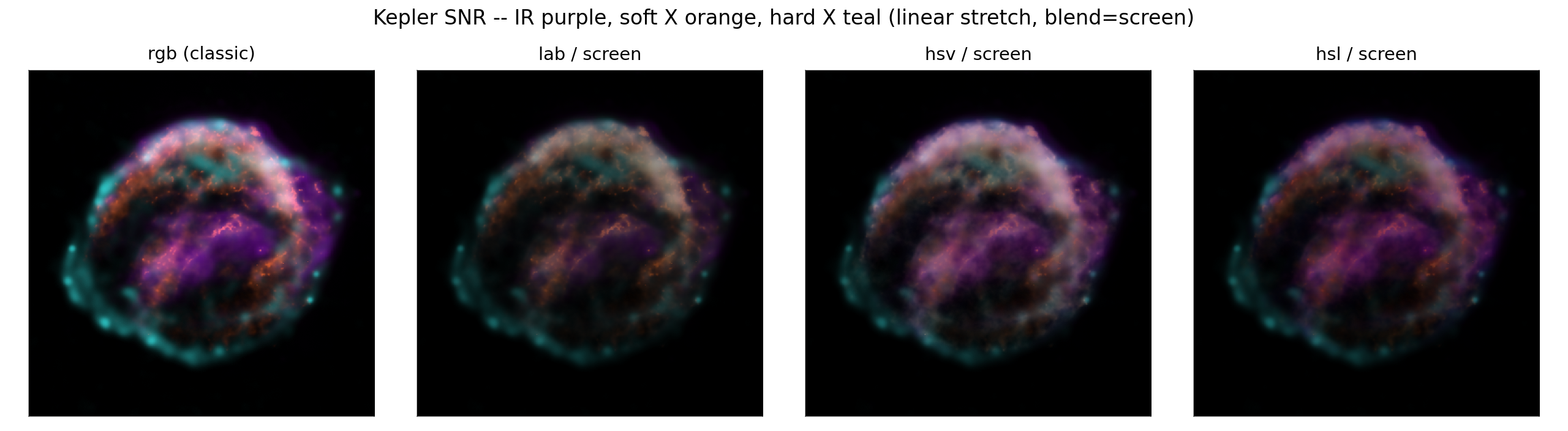
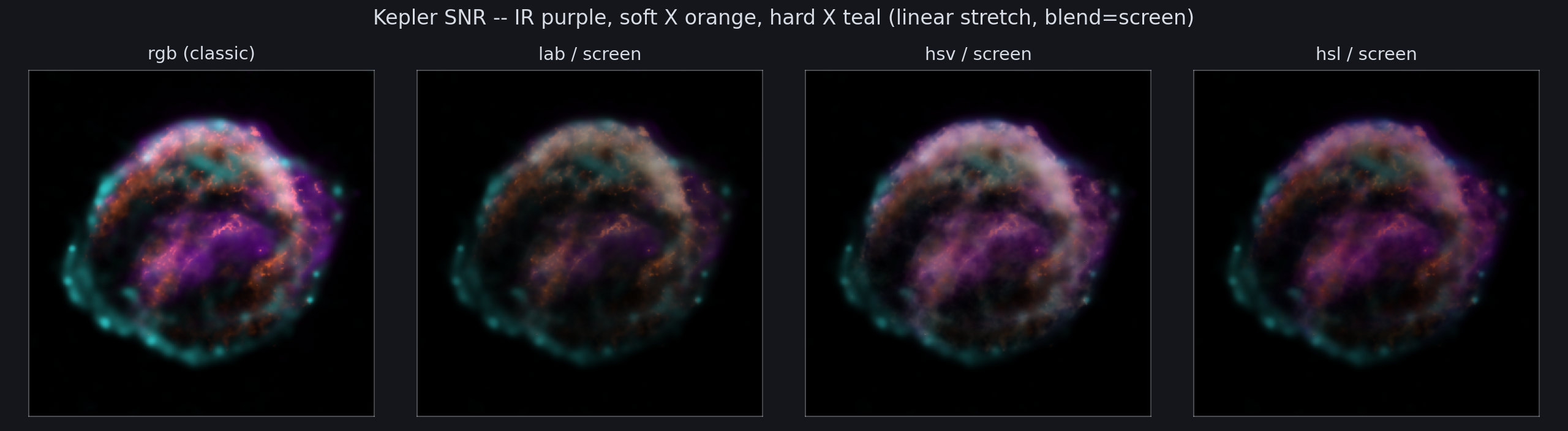
Side-by-side comparisons of classic RGB vs Lab / HSV / HSL on Kepler SNR and
NGC 602. Prefer combine_mode='lab' with blend='screen' as the
general-purpose alternative to classic RGB; treat HSV / HSL as experimental.
Guide: Color compositing. Short tutorial twin:
Color-space compositing. Generator:
examples/compare_colorspaces.py.
Which mode?#
Goal |
Recommendation |
|---|---|
Match classic publications |
RGB |
Rich overlaps, avoid white clipping |
Lab / screen (GUI default) |
Strong per-layer hue separation |
Lab / max |
Paint-like mixing |
RYB + white/custom background |
Hue-vector experiments |
HSV / HSL (watch palette balance) |
import multicolorfits as mcf

combined = mcf.combine_colorized_layers(
    colorized_layers,
    mode='lab',
    blend='screen',
    gamma=2.2,
    background='black',
)
Use the navbar plot-color control to flip light / dark figure chrome.
Kepler SNR — color spaces#
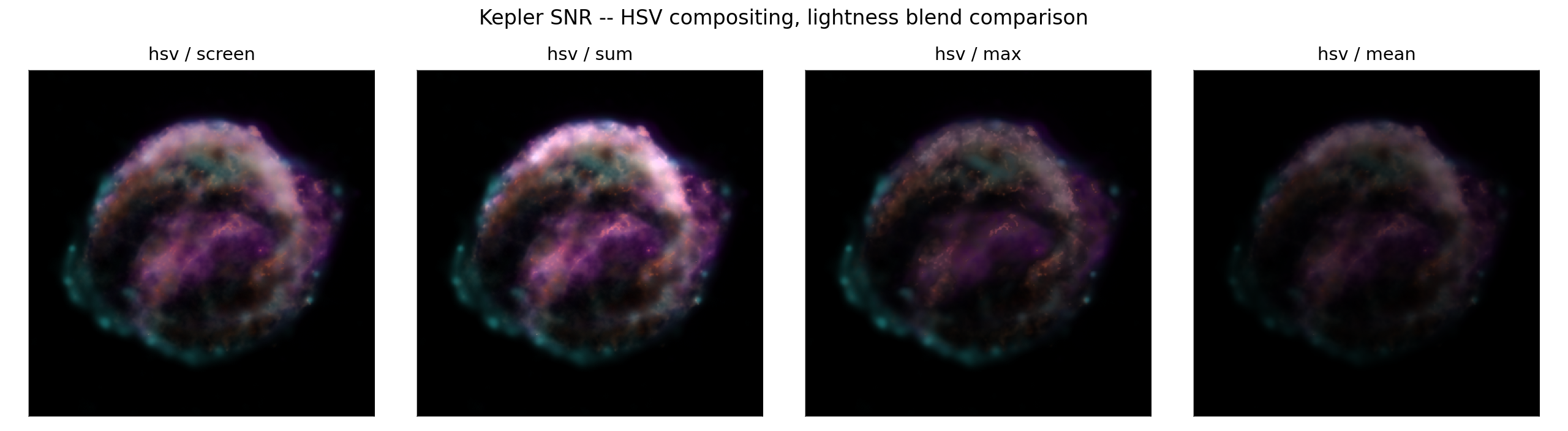
Infrared / soft X-ray / hard X-ray — purple / orange / teal (classic linear stretches; optical WFPC2 omitted — it only covers a tiny corner of the field).
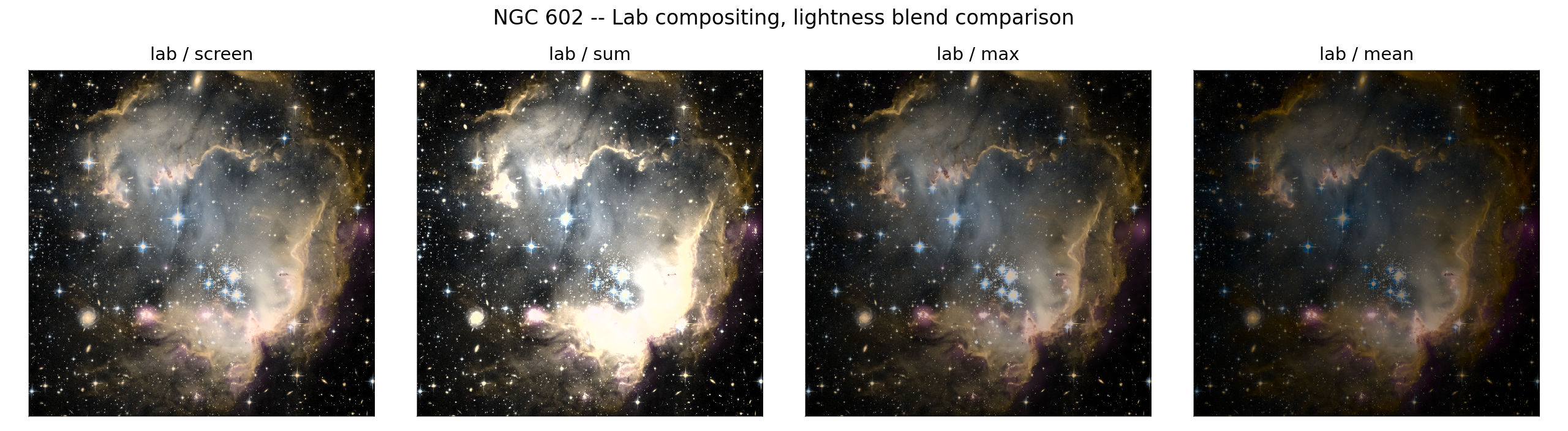
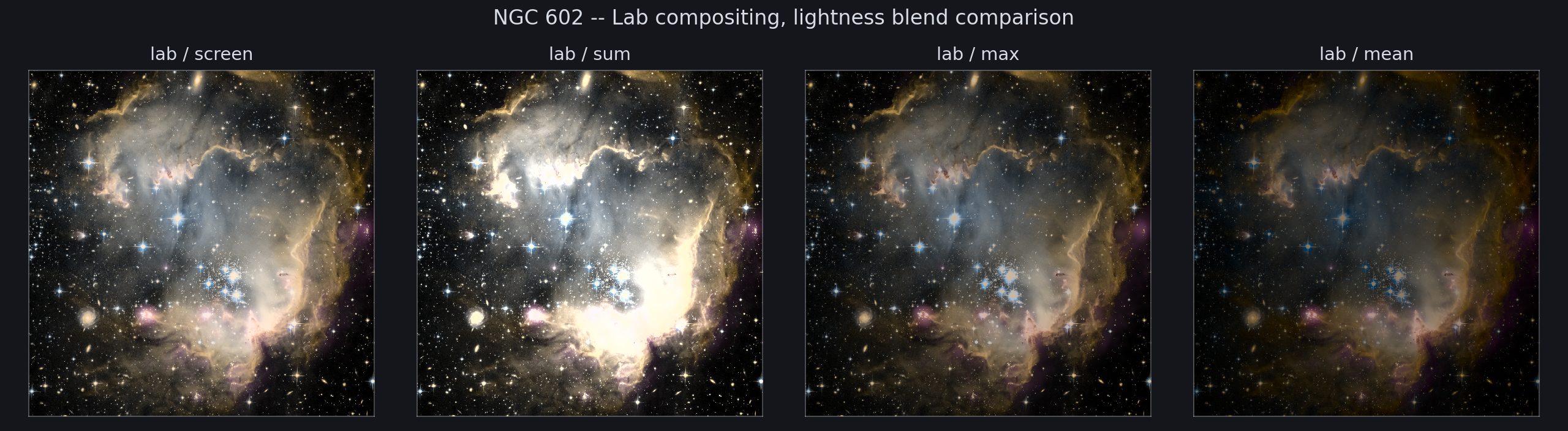
Lab lightness blends#
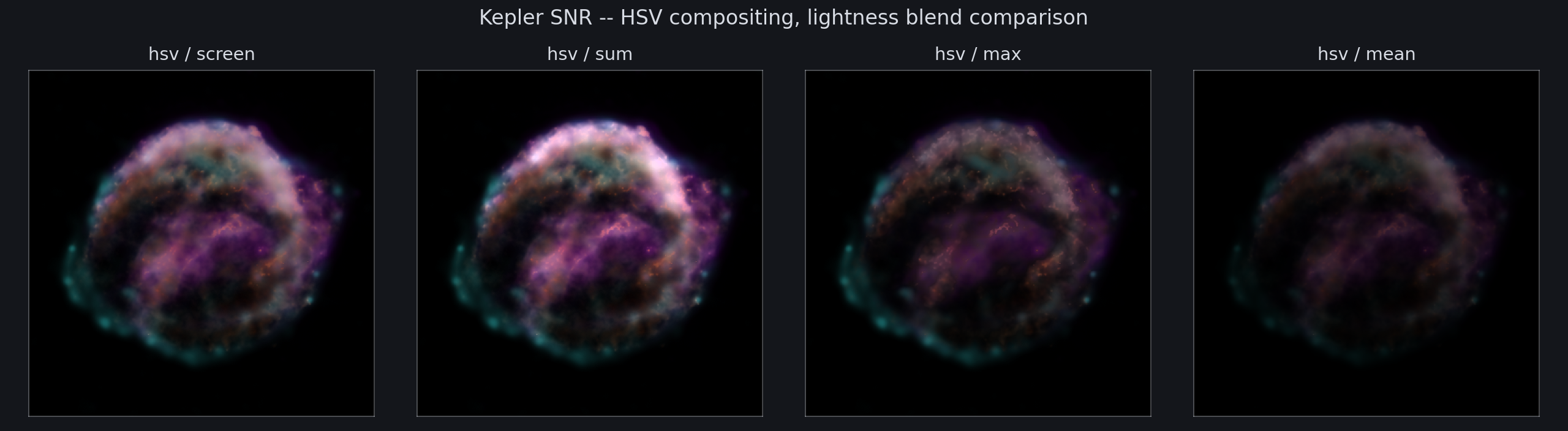
HSV lightness blends#
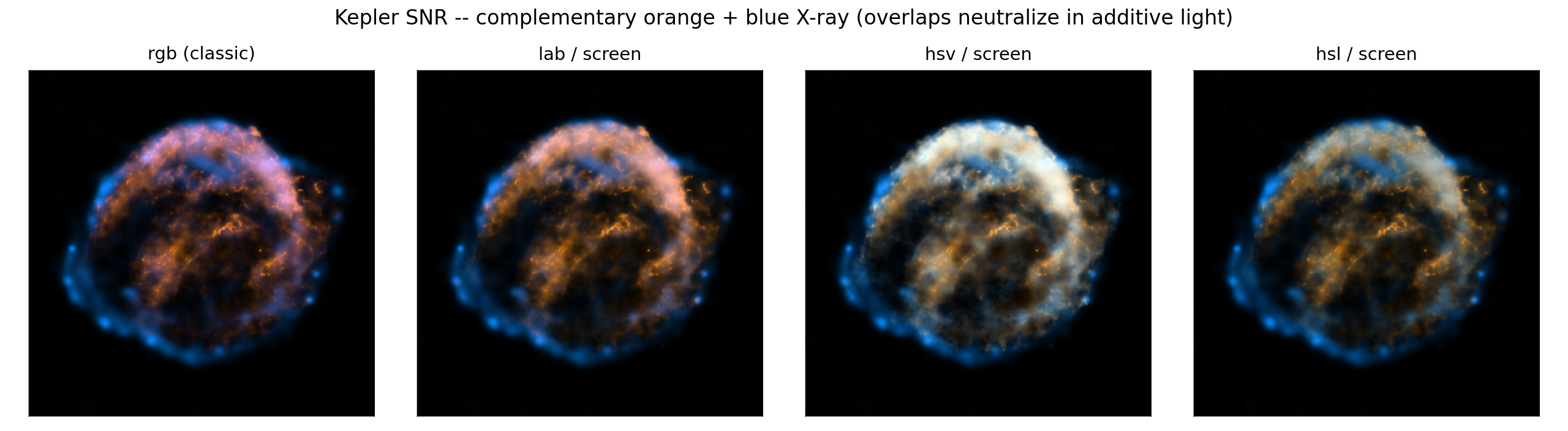
Complementary stress test#
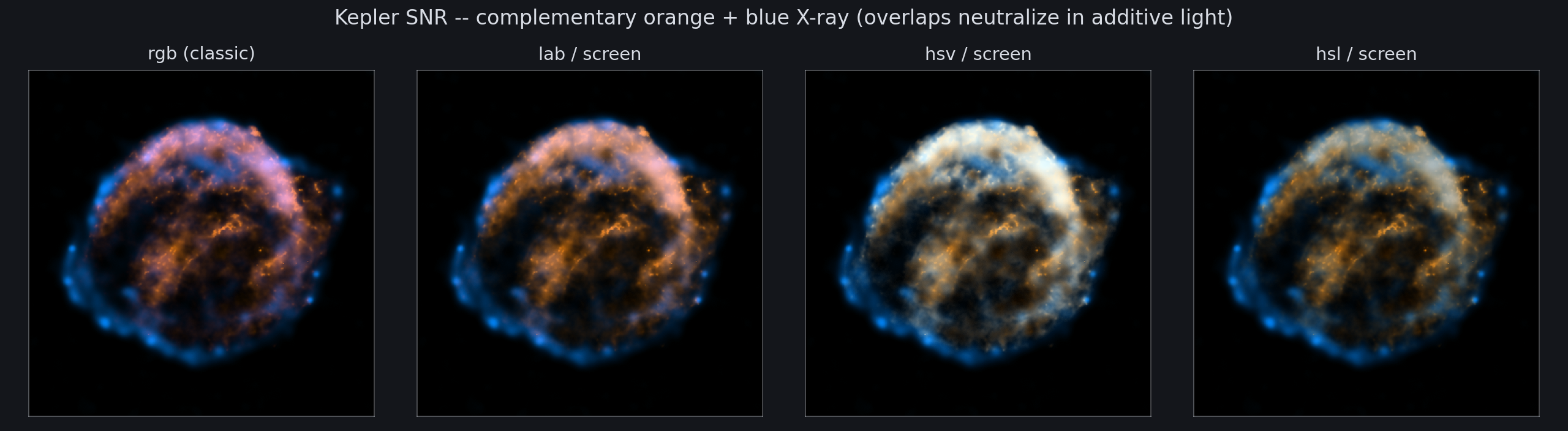
Equal-brightness complementary hues cancel toward grey in additive models — physics, not a bug. Palettes help when both bands must stay vivid. Soft + hard X-ray (same stretch as above) so overlaps fill the remnant, not the tiny optical corner.
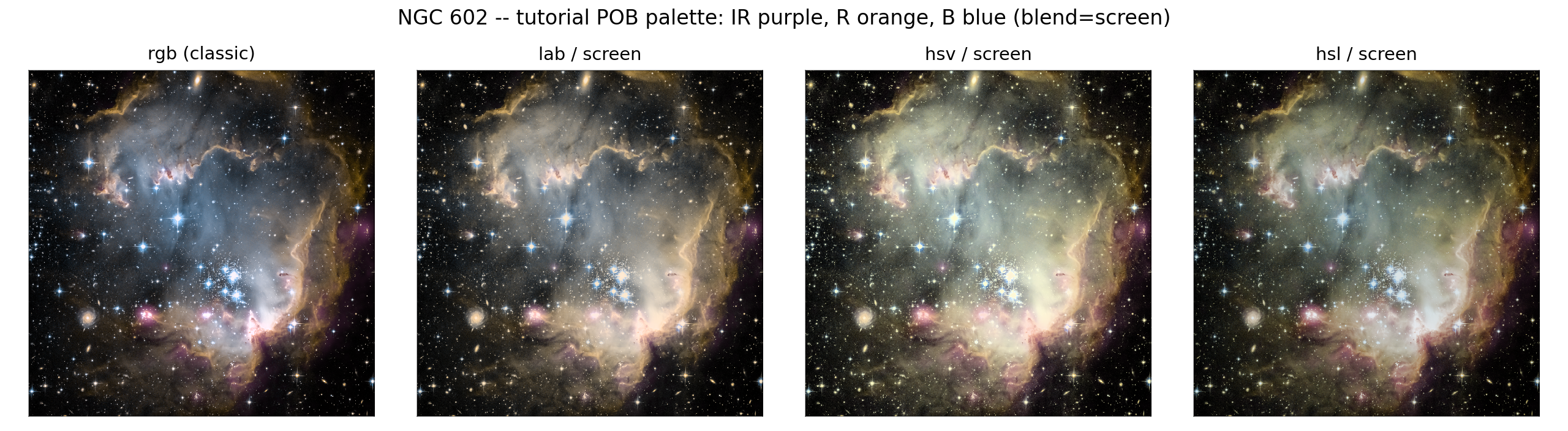
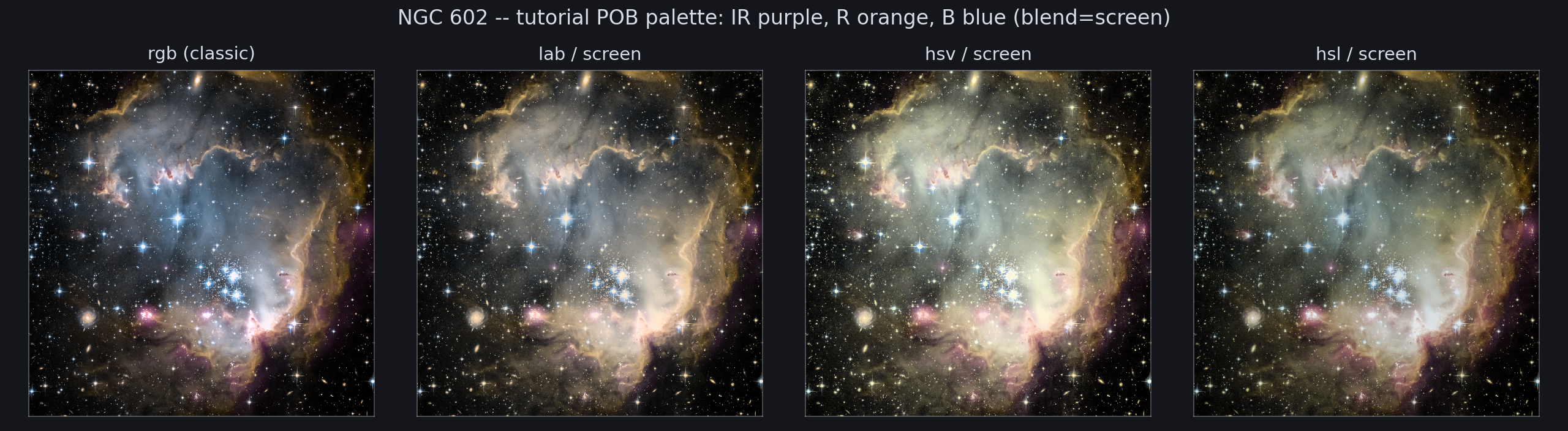
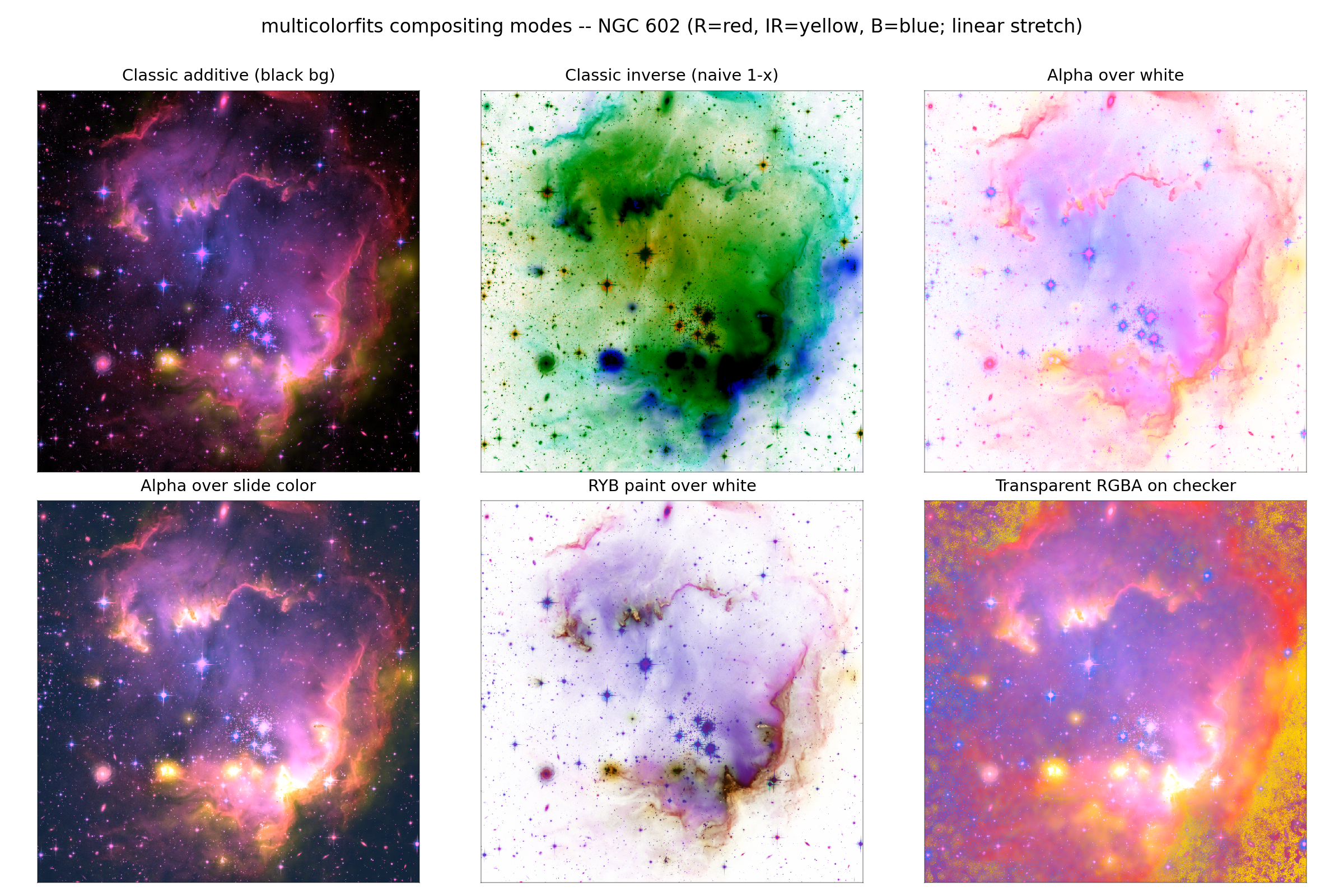
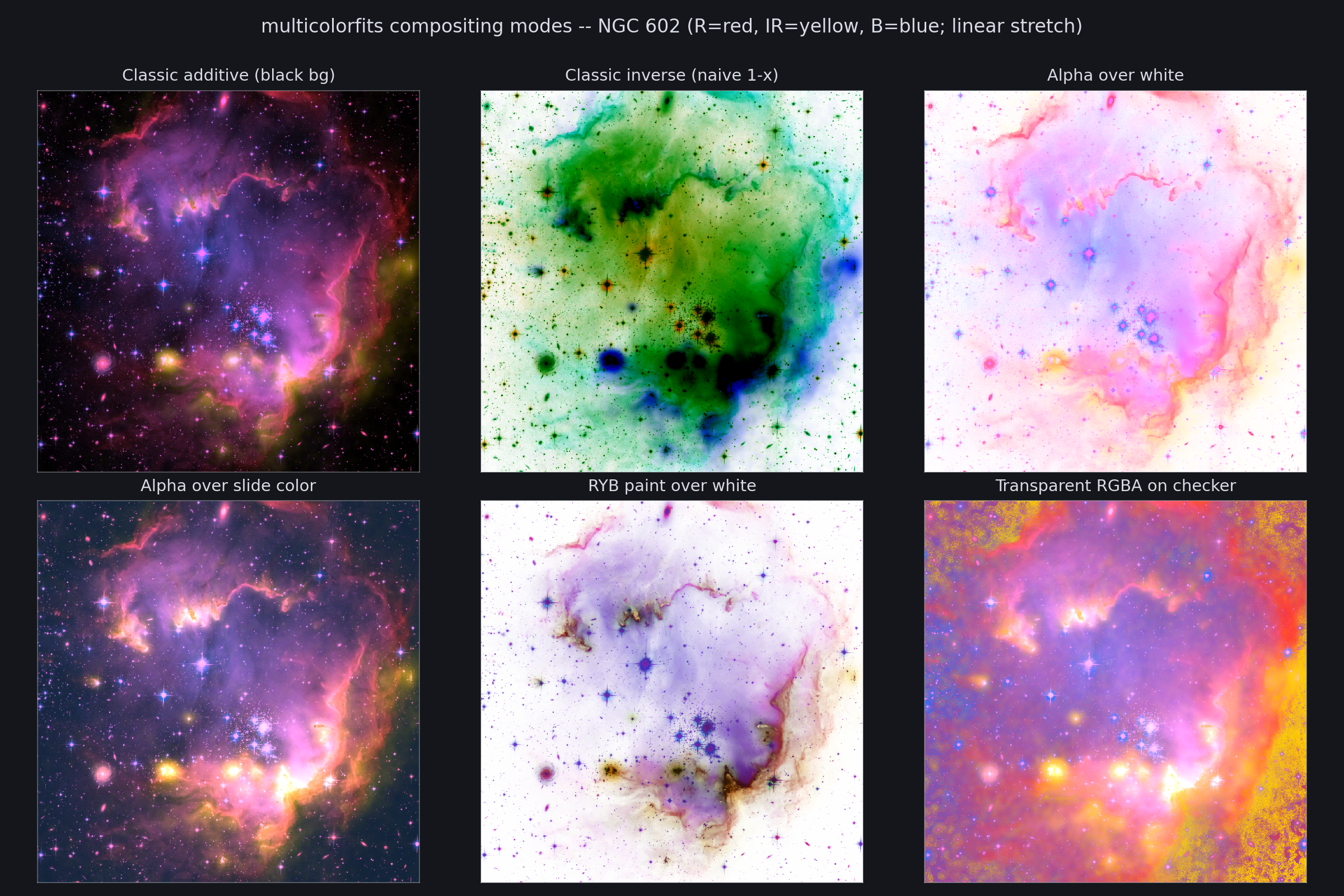
NGC 602 — three bands#
Same POB palette as NGC 602 — three bands, one decision.
Subtractive paint (RYB)#
Same NGC 602 linear stretch as the grids above; only the layer colors (R / yellow / B) and compositing mode change — so the RYB panel is comparable to classic additive, not a zscale retune.
Interpreting the results#
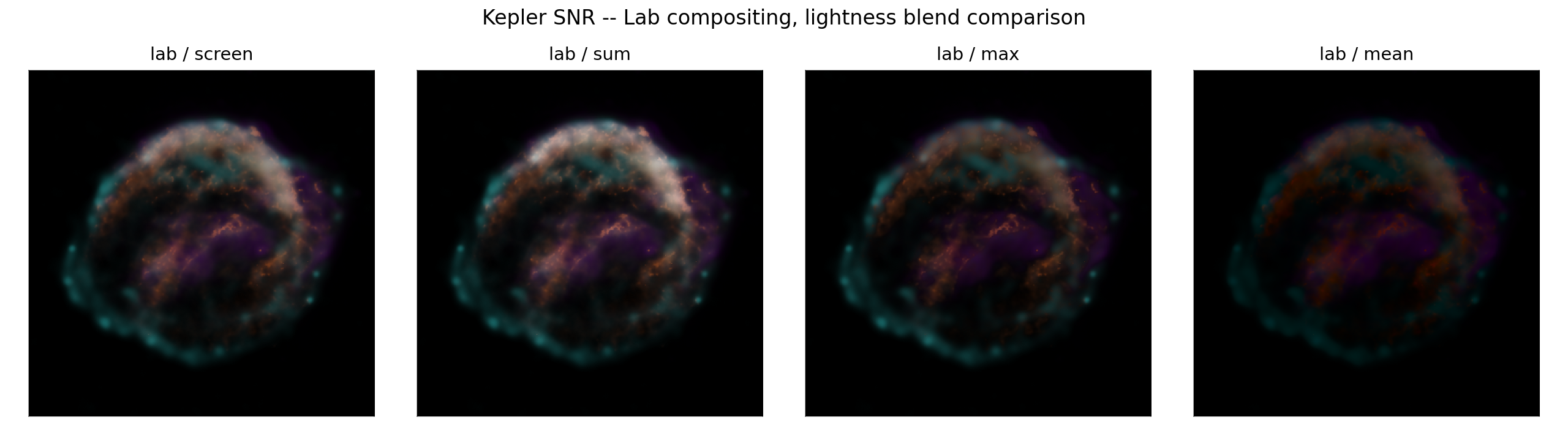
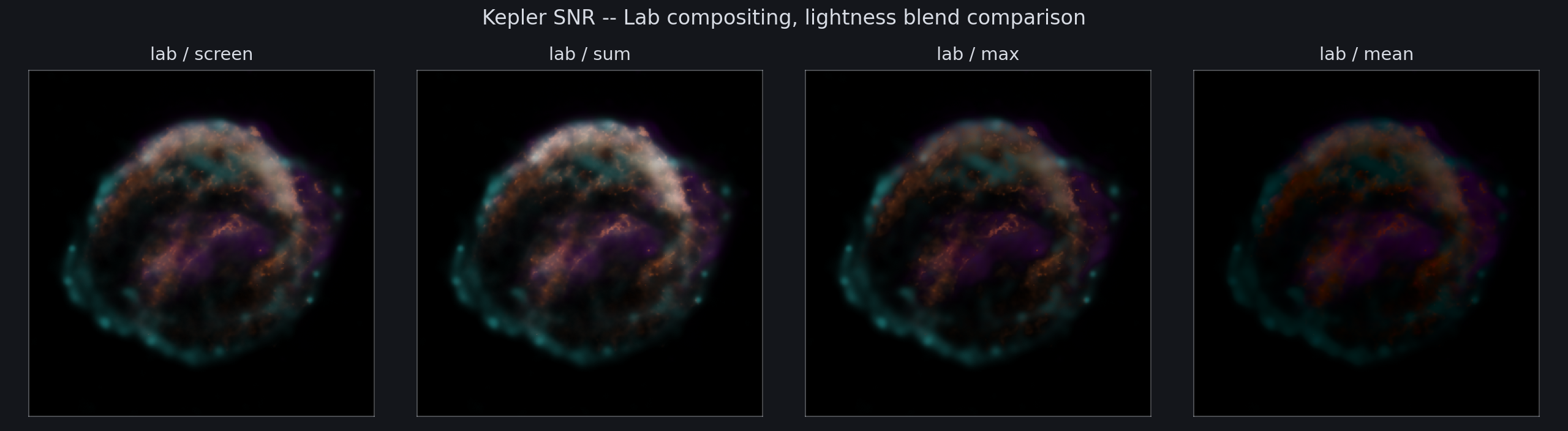
lab / screen— best general-purpose alternative to classic RGB; overlaps keep hue longer instead of clipping to white.lab / max— preserves per-layer hues most faithfully.lab / sum— closest to classic RGB inside Lab; rarely best.mean— dims the composite; better formix_colors_hexthan science images.hsv/hsl— can shift global cast when the palette is unbalanced around the hue wheel; keep experimental.
Reproduce#
python examples/compare_colorspaces.py   # light+dark pairs → examples/output/
python docs/make_docs_figures.py         # copy into docs/_static/compositing/
Helper pattern used by the generator (abridged):
def composite(colorized, mode, blend='screen', gamma=2.2):
    if mode == 'rgb':
        return mcf.combine_multicolor(colorized, gamma=gamma)
    return mcf.combine_multicolor_colorspace(
        colorized, colorspace=mode, blend=blend, gamma=gamma)