"""
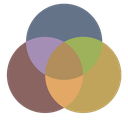
Curated color palettes and palette tools for multi-layer composites.
Choosing well-separated colors is one of the harder parts of building a
multicolor image. This module provides:
* Curated palettes suited to 2–5 layer astronomical composites (including
sets used in published multicolorfits examples), plus general hue-geometry
and color-vision-friendly collections.
* ``suggest_colors(n)`` — *n* perceptually spaced colors on a constant
lightness / chroma ring in CIE LCh.
* Paletton-style hue patterns (complement, triad, square, split-complement,
analogous) via ``colors_for_hue_pattern``.
* ``rotate_colors_from_base`` — rotate a palette around the hue wheel while
keeping relative spacing between layers.
* ``check_palette_colorblind`` — check distinguishability under color-vision
deficiency simulation.
"""
import numpy as np
from skimage import color as ski_color
from .core.colorize import hex_to_rgb, rgb_to_hex
from .core.colormix import simulate_colorblindness
__all__ = [
'PALETTES', 'HUE_PATTERNS', 'PALETTE_MENU',
'list_palettes', 'list_hue_patterns', 'list_palette_menu',
'get_palette', 'suggest_colors', 'colors_from_hue_angles',
'colors_for_hue_pattern', 'hex_to_lch', 'rotate_colors_from_base',
'check_palette_colorblind', 'is_palette_name',
]
# ------------------------------------------------------------------ static palettes
PALETTES = {
# Classic additive primaries
'rgb': ['#FF0000', '#00FF00', '#0000FF'],
# Red-yellow-blue (as in the kepler_RYB example image)
'ryb': ['#C11B17', '#EAC117', '#2B65EC'],
# Red-yellow-blue-purple (as in the m101_RYBP example image)
'rybp': ['#C11B17', '#EAC117', '#4677F0', '#B048B5'],
# Purple-orange-blue (the NGC 602 example in the docs)
'pob': ['#BE599E', '#DEA215', '#77C0F9'],
# Warm sequence for 2-4 layers of similar emission
'warm': ['#7D0541', '#C11B17', '#E8862C', '#EAC117'],
# Cool sequence
'cool': ['#4B0082', '#2B65EC', '#43BFC7', '#8AFB17'],
# Teal/orange complement pair -- high contrast for 2 layers
'tealorange': ['#008080', '#E8862C'],
# Magenta/green complement pair
'magentagreen': ['#C71585', '#3EA055'],
# Colorblind-safe (subset of Wong 2011, Nature Methods)
'cb_safe': ['#D55E00', '#F0E442', '#009E73', '#56B4E9', '#CC79A7'],
# Paul Tol "bright" qualitative scheme
'tol': ['#4477AA', '#EE6677', '#228833', '#CCBB44', '#66CCEE', '#AA3377'],
# IBM Design Library accessible palette
'ibm': ['#648FFF', '#785EF0', '#DC267F', '#FE6100', '#FFB000'],
}
# Hue-geometry pattern names (resolved dynamically for n layers).
HUE_PATTERNS = ('complement', 'triad', 'split', 'square', 'analogous')
# Menu structure for GUIs: (group label, [(label, key), ...]).
# ``perceptual`` and hue-pattern keys are resolved in ``palette_colors_for``.
PALETTE_MENU = [
('Hue geometry', [
('Even (auto-N)', 'perceptual'),
('Complement (180°)', 'complement'),
('Triad (120°)', 'triad'),
('Split complement', 'split'),
('Square / tetrad (90°)', 'square'),
('Analogous (30° steps)', 'analogous'),
]),
('General moods', [
('Pastel ring', 'pastel'),
('Vivid ring', 'vivid'),
]),
('CVD-friendly', [
('Wong (cb_safe)', 'cb_safe'),
('Tol bright', 'tol'),
('IBM accessible', 'ibm'),
]),
('From examples', [
('RGB primaries', 'rgb'),
('RYB paint', 'ryb'),
('RYBP', 'rybp'),
('POB (NGC 602)', 'pob'),
('Warm sequence', 'warm'),
('Cool sequence', 'cool'),
('Teal / orange', 'tealorange'),
('Magenta / green', 'magentagreen'),
]),
]
# Fixed angle offsets (degrees) for Paletton-style patterns (first hue at rotation).
_PATTERN_ANGLES = {
'complement': [0., 180.],
'triad': [0., 120., 240.],
'split': [0., 150., 210.],
'square': [0., 90., 180., 270.],
'analogous': [0., 30., 60., 90., 120.],
}
def _init_generated_palettes():
PALETTES['pastel'] = suggest_colors(5, lightness=78., chroma=38., hue_start=20.)
PALETTES['vivid'] = suggest_colors(5, lightness=55., chroma=72., hue_start=10.)
[docs]
def list_palettes():
"""
Return the names of curated (static) palettes.
See also :func:`list_palette_menu` for the GUI-oriented listing that
includes dynamic hue patterns.
"""
return sorted(PALETTES)
[docs]
def list_hue_patterns():
"""Names of dynamic hue-geometry patterns."""
return list(HUE_PATTERNS)
def is_palette_name(name):
"""True if ``name`` is a known palette or hue pattern."""
return (name in ('perceptual', 'suggest', 'auto')
or name in PALETTES or name in _PATTERN_ANGLES)
[docs]
def get_palette(name, n=None):
"""
Get a curated palette by name.
Parameters
----------
name : str
One of list_palettes() or a hue pattern from list_hue_patterns().
n : int or None
If given, return only the first n colors (must be <= palette length
for static palettes).
Returns
-------
list of str
Hex color strings.
"""
if name in _PATTERN_ANGLES:
if n is None:
n = len(_PATTERN_ANGLES[name])
return colors_for_hue_pattern(name, n)
if name not in PALETTES:
raise KeyError('Unknown palette %r; available: %s' % (name, list_palettes()))
colors = list(PALETTES[name])
if n is not None:
if n > len(colors):
raise ValueError('Palette %r has only %d colors' % (name, len(colors)))
colors = colors[:n]
return colors
def hex_to_lch(hex_color):
"""CIE LCh (degrees) for a hex color."""
rgb = np.array(hex_to_rgb(hex_color), dtype=float) / 255.
lab = ski_color.rgb2lab(rgb.reshape(1, 1, 3))[0, 0]
L, a, b = lab
C = float(np.hypot(a, b))
h = float(np.degrees(np.arctan2(b, a)) % 360.)
return L, C, h
def _lch_to_hex(L, C, h_deg):
h = np.deg2rad(float(h_deg))
lab = np.array([[[float(L), C * np.cos(h), C * np.sin(h)]]])
rgb = np.clip(ski_color.lab2rgb(lab), 0, 1)[0, 0]
return rgb_to_hex(tuple(int(round(v * 255)) for v in rgb)).upper()
def colors_from_hue_angles(angles_deg, rotation=0., lightness=65., chroma=55.):
"""
Build hex colors from hue angles (degrees) on a constant L/C ring in CIE LCh.
Parameters
----------
angles_deg : sequence of float
Hue offsets in degrees (added to ``rotation``).
rotation, lightness, chroma : float
Ring parameters.
Returns
-------
list of str
Hex color strings.
"""
angles = np.asarray(angles_deg, dtype=float)
if angles.size < 1:
return []
hues = np.deg2rad(rotation + angles)
n = len(angles)
lab = np.stack([np.full(n, float(lightness)),
chroma * np.cos(hues),
chroma * np.sin(hues)], axis=-1).reshape(1, n, 3)
rgb = np.clip(ski_color.lab2rgb(lab), 0, 1)[0]
return [rgb_to_hex(tuple(int(round(v * 255)) for v in c)).upper() for c in rgb]
[docs]
def suggest_colors(n, lightness=65., chroma=55., hue_start=25.):
"""
Generate n perceptually evenly-spaced colors: equally spaced hue angles
on a constant-lightness, constant-chroma ring in CIE LCh space.
Because the spacing is perceptual (unlike naive HSV hue stepping), the
colors remain distinct for any n, and equal lightness means no layer
visually dominates.
Parameters
----------
n : int
Number of colors.
lightness : float
CIE L* of the ring [0..100]. Higher = pastel, lower = deep.
chroma : float
CIE chroma of the ring. Higher = more saturated (large values may
clip at the sRGB gamut boundary for some hues).
hue_start : float
Hue angle in degrees of the first color.
Returns
-------
list of str
Hex color strings.
"""
if n < 1:
raise ValueError('n must be >= 1')
angles = hue_start + np.arange(n) * 360. / n
return colors_from_hue_angles(angles, rotation=0., lightness=lightness, chroma=chroma)
[docs]
def colors_for_hue_pattern(pattern, n, rotation=0., lightness=65., chroma=55.):
"""
Colors for a Paletton-style hue relationship, adapted to ``n`` layers.
When more layers are loaded than the pattern defines, extra hues are
inserted at even intervals around the wheel (after the pattern anchors).
"""
if n < 1:
return []
if pattern in ('perceptual', 'suggest', 'auto', 'even'):
return suggest_colors(n, lightness=lightness, chroma=chroma, hue_start=rotation)
if pattern not in _PATTERN_ANGLES:
raise KeyError('Unknown hue pattern %r' % pattern)
base = list(_PATTERN_ANGLES[pattern])
if n <= len(base):
return colors_from_hue_angles(base[:n], rotation=rotation,
lightness=lightness, chroma=chroma)
extras = list(np.linspace(0., 360., n - len(base) + 1, endpoint=False))[1:]
merged = (base + extras)[:n]
return colors_from_hue_angles(merged, rotation=rotation,
lightness=lightness, chroma=chroma)
[docs]
def rotate_colors_from_base(base_hex_colors, delta_deg):
"""
Rotate layer colors around the hue wheel, preserving each color's L/C and
its angular offset from the first layer.
Parameters
----------
base_hex_colors : list of str
Starting hex colors (one per layer).
delta_deg : float
Rotation to apply in degrees.
Returns
-------
list of str
Rotated hex colors.
"""
if not base_hex_colors:
return []
lchs = [hex_to_lch(h) for h in base_hex_colors]
h0 = lchs[0][2]
offsets = [(h - h0) % 360. for (_, _, h) in lchs]
new_h0 = (h0 + float(delta_deg)) % 360.
return [_lch_to_hex(L, C, (new_h0 + off) % 360.) for (L, C, _), off in zip(lchs, offsets)]
[docs]
def check_palette_colorblind(hex_colors, kind='deuteranopia', min_distance=25.):
"""
Check whether a palette's colors remain distinguishable under a color
vision deficiency, by simulating the CVD and measuring pairwise CIELAB
distances.
Parameters
----------
hex_colors : list of str
Palette to check.
kind : str
'protanopia', 'deuteranopia' (default), or 'tritanopia'.
min_distance : float
Minimum acceptable pairwise Delta-E (CIE76). ~25 is comfortably
distinguishable for large image regions.
Returns
-------
(bool, list)
(all pairs pass, list of (i, j, distance) for failing pairs)
"""
rgb = np.array([np.array(hex_to_rgb(h)) / 255. for h in hex_colors]).reshape(1, -1, 3)
sim = simulate_colorblindness(rgb, kind=kind)
lab = ski_color.rgb2lab(sim)[0]
failures = []
for i in range(len(hex_colors)):
for j in range(i + 1, len(hex_colors)):
dist = float(np.linalg.norm(lab[i] - lab[j]))
if dist < min_distance:
failures.append((i, j, dist))
return (len(failures) == 0), failures
_init_generated_palettes()